Thursday, September 20, 2012

Fiestas de Paccha, Parte Dos

10 Reasons to Love Small-Town Fiestas
 
 
Reason #1: The Food


Here, we have a cored half pineapple stuffed with three flavors of ice cream and topped with syrup, vanilla cookies, and sprinkles. 

The myriad pointy things sticking out of it are meant to be used as utensils.


Whitni demonstrates the usefulness of the straw, which may be employed to access the pineapple juice sitting below the level of the ice cream.


Get it, girl.
Reason #2: Dancing with Guns
 

Welcome to the rodeo.
 
Reason #3: Everybody's There
 
  
  Everybody, everybody.
The entire town.


     Reason #4: Pomp and Circumstance

It's all very pompous and circumstantial.
There must be at least one parade per day.
Today's was at the rodeo, as each participating hacienda
sent their team out to represent.
 
Reason #5: Prizes
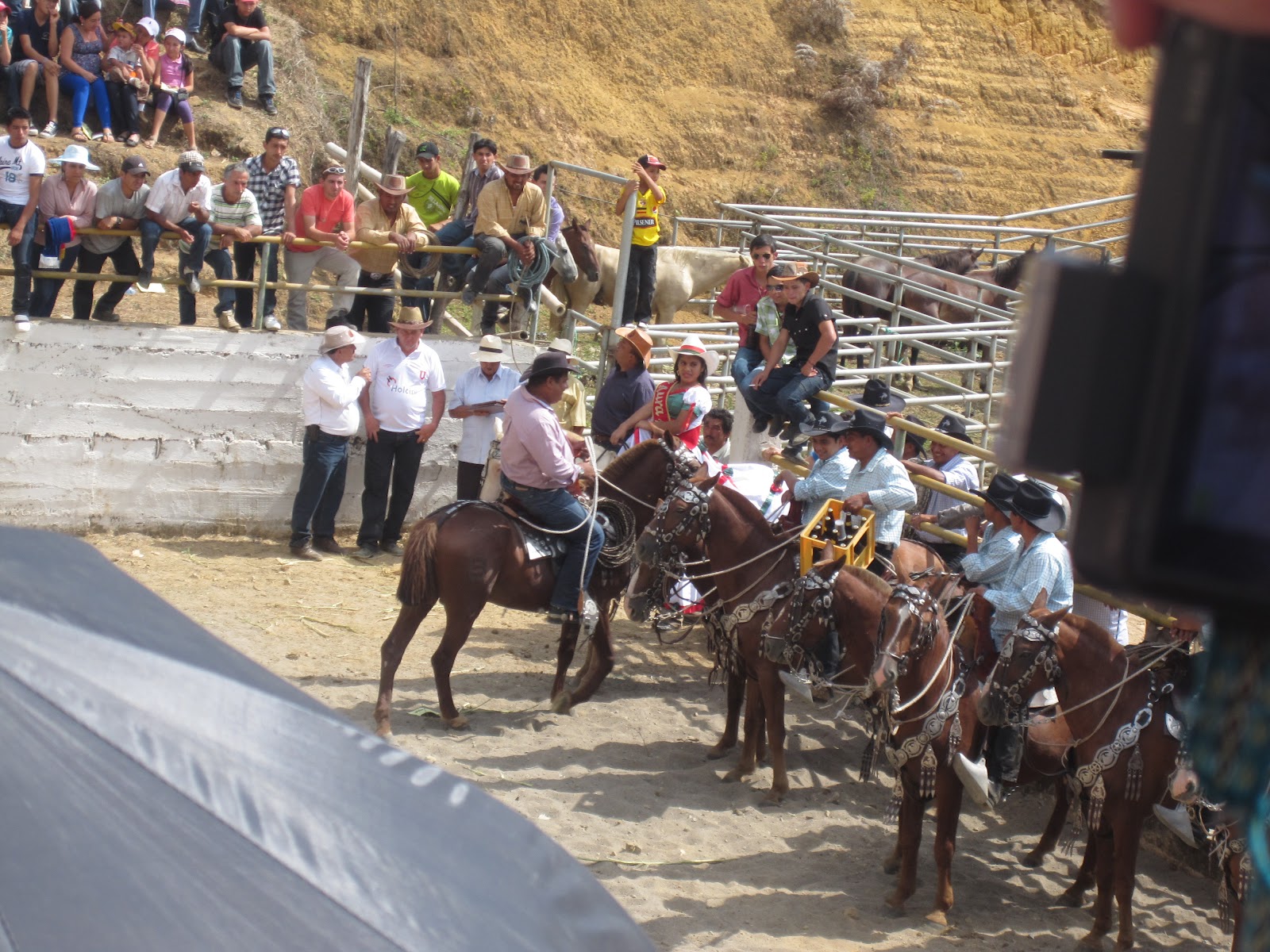

In this case, the prize (for parading the best) was a jaba --
a crate of 12 Pilseners.
Just what you need before attempting to ride a buckin' bronco.
 
Reason #6: Watching Other People Do Dangerous Things While You Sit In Relative Safety


Reason #7: The Food, Again


Choclo con queso:
corn on the cob,
covered in cheese crumbs, on a stick. 

This is a popular Ecuadorian snack and may be commonly found throughout the coast and the Sierra.
 

Reason #8: Clowns
In this case, rodeo clowns.


Reason #9: Música!
 
 
Reason #10: Paragliders
 

Granted, this is not a usual feature of small-town fiestas and should technically be included as a subcategory of #6.  In this instance, however, I made an exception, seeing as how the entire crowd watching a paraglider approach from the outlying mountains; waiting in anticipation as he landed just outside the rodeo grounds; and cheering wildly upon his grand entrance, provided a stunning conclusion to the rodeo.  Que viva Paccha!

Sunday, September 16, 2012

A Tuna is Not a Fish

Tuna fish is eaten in coastal Ecuador fairly frequently.  It's considered something of a fast food, and you'd be "cheating" and not "really cooking" if you used it in your kitchen at home.  Nevertheless, people do open a can of tuna and dump it on top of stewed vegetables as a last-minute meal, or they mix it in with chilled pasta, hardboiled eggs, herbs, and lots of mayonnaise as a main course salad. 

If you come here and ask for tuna, however, you will not receive what you think you asked for. 

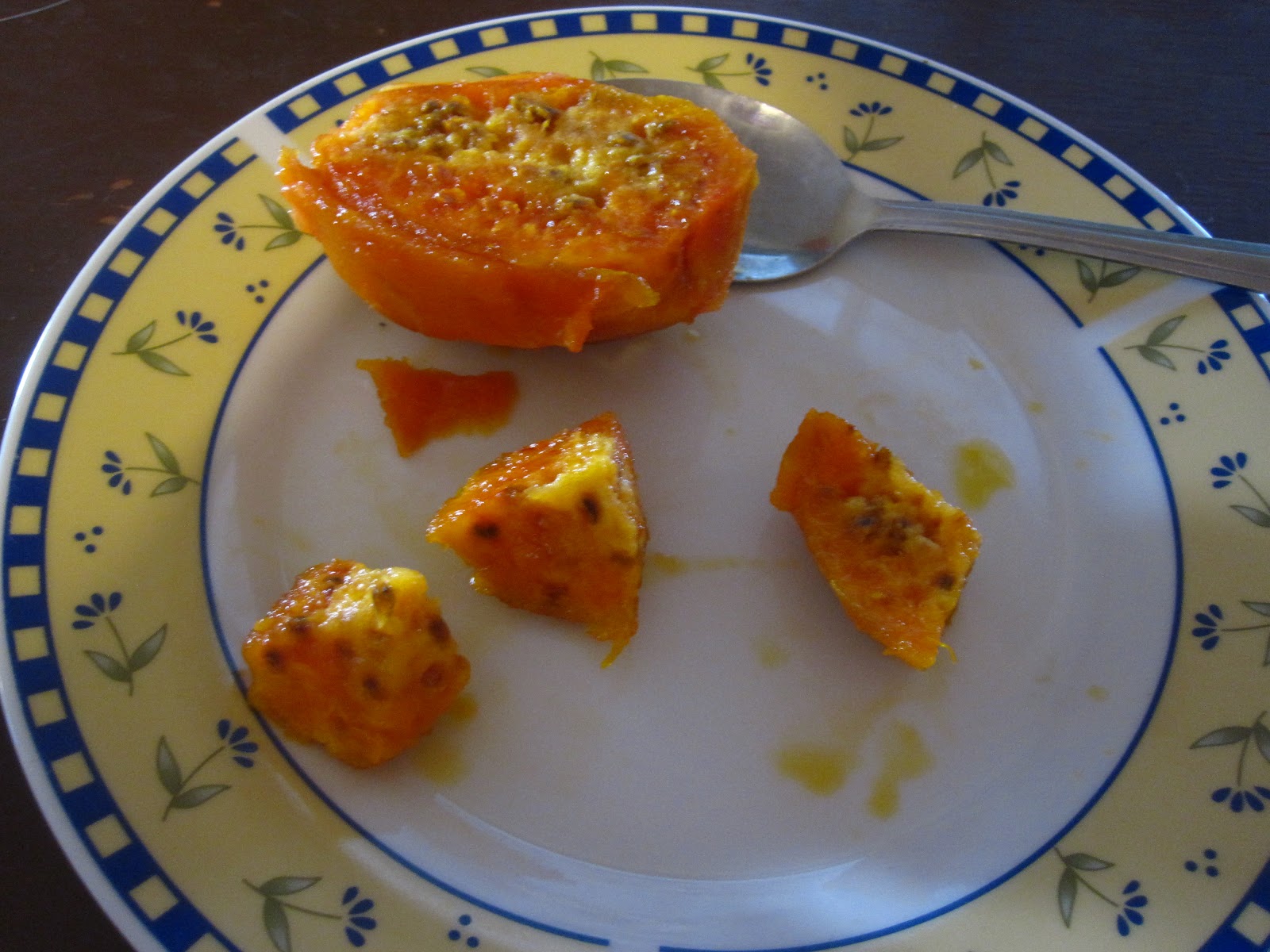
If you come here and ask for tuna, this is what you will get:


The edible fruit of a prickly pear cactus.

(If you come here and ask for atún, then you will receive fish in a can:


Most canned tuna comes in oil as opposed to water, making tuna the decidedly healthier snack option.)

Back to the tuna.


You can find them in supermarkets as well as outdoor markets. I've found that the supermarket versions are more reliably de-prickled, although I've still managed to get some spines stuck in my hand. Careful with these guys; you'll definitely want to make sure you get the skin off before putting the tuna anywhere near your mouth.

Once the skin is off, you can dig right in and eat it like an apple, or you can be civilized like me and Emily Post and cut it up as shown below.
 
 
The heart of the fruit is juicy and full of flavor, making it the perfect snack for a hot, sunny day.
 
You can't leave the table till you eat your cactus,
jordan

Saturday, September 8, 2012

Fiestas de Paccha, Parte Uno

Last month, I visited my friend Whitni in her site of Paccha, in the cloud forest of Ecuador.  I brought two dozen live crabs as a gift from the coast for her host family, and we had fun with those.  After we ate them, we all settled back for an afternoon of watching the Olympics on TV, eventually all dozing off during the speedwalking marathon.  (It was a very exciting event, but we were very full of crab.)
 
The next day, however, marked the last day of Paccha's town festivals.  Town festivals are usually a good excuse for not getting much work done for about a month - I'm talking about for the townspeople, not for Peace Corps volunteers.  It is difficult, however, to get much work done when nobody else in town is doing much of anything.  On the last day of festivities in Paccha, not much work got done, but there was definitely no dozing permitted.  We had a full day, starting with Whitni's host family calling us over and telling us to report immediately to the local elementary school.  Knowing better than to ask questions, we got ready and headed over to the school.  We showed up to bleachers full of people ready to watch the school's presentation in honor of the festivals of Paccha.  They went a little something like this:
 

Dancing.
 

Munchkins.


Dancing munchkins.

(This, by the way, is why Ecuadorians can dance and Americans cannot: they learn it in school at age 5.)
 

The teachers were on standby to guide any stray munchkins who forgot the choreography.


These traditional dances usually involve the men (boys) and women (girls) splitting up and performing separately at some point during the routine.


My favorite part of the performance was when Emilia, the little girl in Whitni's host family, decided that she, too, wanted to be a part of the school dance.  She wriggled out of her mother's arms and began climbing down the bleachers.  Various adults picked her up and handed her down to the next row until she had reached the ground.  She walked over to the dancing girls and stepped right into the circle.


Precocious, much?
 
Next up came the teachers and staff:
 

Their performance was very similar to the children's, the chief difference being that they knew all the choreography and did not need teachers blowing whistles to signify the next part of the routine.


Also, they were perhaps more graceful than the munchkins, all flowing skirts and broad shoulders.


Little Emilia returned to her seat for this number. 
 
And that's what you can expect to see at a school presentation during the town festival.  This was only the first part of our day.  Upon the end of the dancing, Whitni and I prepared for what came next, the main attraction of the Paccha festival and what the townspeople had waited all month for: the rodeo.  To be continued...

Thursday, September 6, 2012

September Garden Update

Before I left for a trip to Peru and Machu Picchu, nearly every one of my family members admonished me to "Take lots of pictures!!!" 
 
Two days into the trip, my camera battery died.  Don't blame me, blame the horse it was riding on; the camera, which was inside a bag lashed on top of a horse, must have been jostled to power on by the gait of the horse, thereby running down the battery while it was inside the bag.
 
But I digress.  This post is not about Machu Picchu, my camera, or the horse - because I don't have pictures.  While I'm waiting on my travel companion to send me her photos, here's a current-day update on the organic community garden.
 

A year ago this month, we planted in fresh soil in our newly built beds.

Today, we planted in second-year soil in newly repaired beds.

We had a few setbacks along the way, including the loss of PCV Mike, who was a major motivator to the group; and, more recently, a two-week period in which the health center next door had no water.


In short, the seedlings we planted a few weeks prior did not survive.  So, we figured it was time for round two.

This time, the group decided to plant the seedlings directly in the beds.  They allocated one end of the bed and prepared the soil with extra care, then divided it into rows and dropped the seeds in.

 
This is a departure from what we did this time last year, but it was the group's decision.  We will see what happens when the seedlings are left in the public domain, where the sunshine and the prying beaks of birds have equal access.  (We endeavored to protect from the birds by partially covering the seeds with a woven sack.)
 
 
Only time will tell the results of this experiment.  Keep your fingers crossed, por favor.
 
Over & out.

Friday, August 31, 2012

Back to Life, Back to Reality


Back in Guayaquil, and I've never been so happy to be home.  It was an epic journey.  The challenges we faced - climbing mountains, battling food poisoning, missing flights, etc. - made it that much more rewarding to come back to the balmy tropics of Ecuador.  Don't get me wrong; spending time in the Sacred Valley of the Incas was well worth the time and money, our trek was gorgeous, and visiting Machu Picchu was a great experience.  There were a few items, however, I would have appreciated knowing beforehand.  Just to be prepared mentally, since being prepared logistically usually doesn't happen for me.  Pending photos and reflections on our trip, here is a list of Useful Things To Know When Traveling to Machu Picchu and the Sacred Valley:

- Visiting Machu Picchu is like working out.  It is the 16th century version of the Stairmaster.  There were lots of out-of-shape tourists there, and you don't want to be one of them.  Start working out now.

- If you're camping at high altitude on the Inca Trail or another trek, fill up a plastic bottle with hot water just before going to bed.  Slip it into your sleeping bag and you've got warm feet for the night.  (Or you can be like me and wear socks made out of possum fur.  Thank you, New Zealand.)

- Even if you speak good Spanish and have no qualms about navigating the local bus system, it really is a good idea to pay for a day tour if you're trying to be efficient with your time and see as much as possible in the Sacred Valley.  Especially if you find yourself hampered by gastrointestinal woes and don't really feel like dealing with waiting on buses or haggling over cab fares.

- Speaking of food poisoning, don't assume you are immune.  Expats, I exhort you to let go of your hubris and consume carefully.  The Incas continue to wreak an interminable revenge on foreign GI tracts after that whole smallpox thing from back in the day.

- Cusco = cold.  Machu Picchu = temperate.  Ergo, neither shorts nor exercise leggings are appropriate.  They are two apparel extremes, neither of which are warranted by the climate.  Layers!  Layers are fine!!  (Really, enough with the exercise leggings, people; the only time you need those are at night if you're camping at high altitude.)

- Bread.  Bread, bread, bread.  Cusco apparently has really good bread.  While we were sitting in the airport terminal for about 5 hours waiting on our delayed plane, we counted dozens of Peruvians carrying plastic sacks that contained round loaves of bread bigger than the size of your head.  This is the "it" item to bring home to your family after a trip to Cusco.  If you really want to blend in with the locals, forget the alpaca blankets and silver jewelry and pack your suitcase with bread instead.

- Inca Kola is everywhere.  People really drink it, and they like it, and they like it when you like it.  Unfortunately, this is part of the culture in which I do not enjoy partaking, and so my description of it here will hardly be impartial: When I see a bottle of Inca Kola, certain phrases run through my head.  Phrases such as "Just Say No" and "Stop, Drop, and Roll."  I suppose the best advice I can give is to simply Be Aware.  Be Aware that what you are about to consume looks like carbonated urine and tastes like liquid bubblegum.

- This little corner of the world is well developed for tourists.  With Machu Picchu being one of the Seven Wonders of the World, you'd have thought we'd be prepared for things like the required purchase of package tourist tickets in order to visit parts of the Sacred Valley, or simply for the sheer number of other tourists around.  There are ways to avoid the toury-ness of it all, which we will get to later.

...That there is a brief rundown.  Ponder those over a bottle of Inca Kola and we'll be back shortly with more trip details.  Over and out.

Friday, August 17, 2012

Hasta Pronto


One of the perks of living in Guayaquil is the large number of direct buses that service not only Ecuador, but other countries as well.  My friend Evergreen and I had heard intriguing rumors about these international buses.  They included such fabulous things as chairs that recline to 180 degrees; air conditioning; and bus attendants who serve you meals.

We decided we had to test the verity of these rumors, and that is why we booked bus tickets to Peru.  (The allure of the mysterious Incan ruins of Machu Picchu had something to do with it as well.)  Yes, it's true: tomorrow, I embark on a long anticipated vacation.  Part of the next twelve days will be spent high in the Andes, without access to my hammock or the internet, so this post will serve as a temporary adieu.  In the meantime, check out this website for a virtual tour of Machu Picchu that probably has better pictures than the ones I am going to take -- nevertheless, I will take pictures, and I will bring them home and post them here because I owe it to you, my dear and loyal readers.  But I'm thinking the pictures I take of all the Peruvian dishes I plan to try will turn out somewhat better. 

"Feliz viaje" is what we say to mean "Have a good trip." 

And to that I respond, "Gracias, nos vemos pronto!"

...See you soon!

Thursday, August 16, 2012

NY Times: Ecuador Grants Asylum to Assange, Defying Britain

"It struck many as odd that Mr. Assange, who shot to fame as a fighter for media freedom, chose Ecuador as a potential refuge. Mr. Correa has presided over a crackdown on journalists there."

Full article is here.